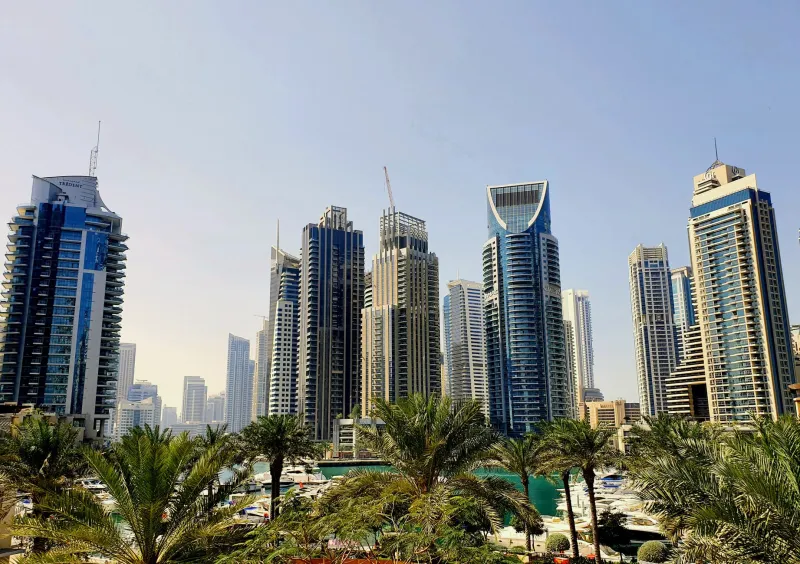
Desert Unicorns: Why Dubai Is Replacing Silicon Valley as the Launch Pad for America's Most Ambitious Founders

Photo: Christopher Michel, CC BY 2.0, via Wikimedia Commons
For decades, the geography of American entrepreneurship has been remarkably predictable. You build a company in San Francisco, pitch on Sand Hill Road, and scale from a Bay Area headquarters. That script is being rewritten — and Dubai is holding the pen.
A rising number of American founders are establishing operational headquarters in the UAE while preserving their US-facing corporate structure, investor networks, and market access. The mechanism enabling this dual-market architecture is, increasingly, the UAE Golden Visa. Understanding why requires looking beyond the headline benefits and examining the structural advantages that serious founders are quietly exploiting.
The Cost Arbitrage Nobody Is Talking About
Silicon Valley's overhead costs are well-documented. Office space in SoMa or Palo Alto, combined with California's state income tax, employer payroll obligations, and the premium required to attract engineering talent, can consume a disproportionate share of early-stage runway. Dubai presents a materially different cost structure.
Free zones such as the Dubai International Financial Centre (DIFC) and Dubai Multi Commodities Centre (DMCC) offer 100 percent foreign ownership, zero corporate tax on qualifying income, and streamlined business setup processes that can be completed in days rather than months. For a Series A company burning $400,000 per month, relocating its product and engineering function to Dubai can extend runway by six to twelve months — a meaningful competitive advantage at any stage.
Golden Visa residency provides the legal foundation for founders to anchor themselves in this environment long-term, without the uncertainty of renewable employment visas or sponsor-dependent arrangements. The ten-year renewable residency status signals permanence to local partners, landlords, and banking institutions in a way that short-term visas simply cannot.
Maintaining the US Cap Table While Building East
One of the most common misconceptions among founders considering an international expansion is that relocating operations requires restructuring their entire corporate and ownership stack. In practice, the founders executing this strategy most effectively are doing nothing of the sort.
The typical architecture involves retaining a Delaware C-Corporation as the primary legal entity for US investors, board meetings, and eventual exit transactions. The Dubai operation is established as a subsidiary or branch entity within a free zone, housing the regional sales team, product development resources, or supply chain management function. Intellectual property may be developed collaboratively between both entities, with careful attention to transfer pricing rules and IRS arm's-length standards.
This structure allows a founder to sit in a Dubai office on a Tuesday, close a deal with a Gulf-based distributor, and then join a Zoom board call with a Sand Hill Road VC on Wednesday afternoon — all without triggering the corporate restructuring conversations that tend to unsettle American institutional investors.
IP Protection in a Jurisdiction Built for It
The UAE has made significant legislative investments in intellectual property protection infrastructure over the past decade. The country is a signatory to the Paris Convention and the Patent Cooperation Treaty, and DIFC in particular operates under a common law framework explicitly designed to provide international founders with familiar legal protections.
For technology companies, SaaS platforms, and any venture where proprietary code or methodology represents a core asset, the ability to develop and register IP in a jurisdiction with robust protections — while maintaining a US parent entity — creates optionality that a purely domestic structure does not offer. Founders in regulated industries such as fintech and healthtech have found that developing certain product features within UAE free zones, where regulatory frameworks differ from US federal and state requirements, accelerates time-to-market for international versions of their platforms.
Case Study Profiles: The New Dual-Market Founders
The Logistics Platform Founder: A Chicago-based entrepreneur who built a regional freight brokerage platform secured a UAE Golden Visa after investing in a Dubai commercial property. Within eighteen months, his company had signed three Gulf Cooperation Council logistics contracts that would have been effectively inaccessible from a US-only corporate presence. His Delaware entity retained all existing US investors; the Dubai subsidiary managed regional operations and local hiring.
The Fintech Architect: A New York-based payments founder used her Golden Visa residency to establish a DIFC-registered entity, enabling her platform to interface with regional banking infrastructure under DIFC's progressive fintech regulatory sandbox. US venture backers remained on the cap table; the Dubai structure allowed her to pursue licensing in Saudi Arabia and Bahrain simultaneously.
The SaaS Entrepreneur: A Texas-based B2B software founder relocated his entire product development team to Dubai Media City, reducing his monthly engineering burn by approximately 35 percent while gaining proximity to enterprise clients across the GCC. His US holding company structure remained unchanged; his Golden Visa provided the stable personal residency status his team needed to build long-term lives in the UAE.
The Strategic Logic of Geographic Optionality
Beyond the operational mechanics, experienced founders recognize that geographic optionality has intrinsic strategic value. A company with genuine dual-market presence — a credible US identity and an established Middle Eastern footprint — occupies a differentiated position in the eyes of both Western institutional investors and Gulf-based strategic acquirers.
Sovereign wealth funds and Gulf family offices, which collectively represent some of the largest pools of private capital on earth, have demonstrated increasing appetite for direct investments in technology and growth-stage companies. A founder who is physically present in Dubai, holds Golden Visa residency, and has built genuine relationships in the local business community is infinitely better positioned to access that capital than one pitching from a San Francisco office at 2:00 AM Gulf Standard Time.
The UAE Golden Visa, in this context, is not merely a residency instrument. It is a market access credential, a relationship signal, and a structural foundation for building a company that is genuinely positioned to compete across hemispheres.
For the American founder willing to look beyond the familiar geography of domestic venture capital, the desert is no longer just a destination. It is a competitive advantage.